
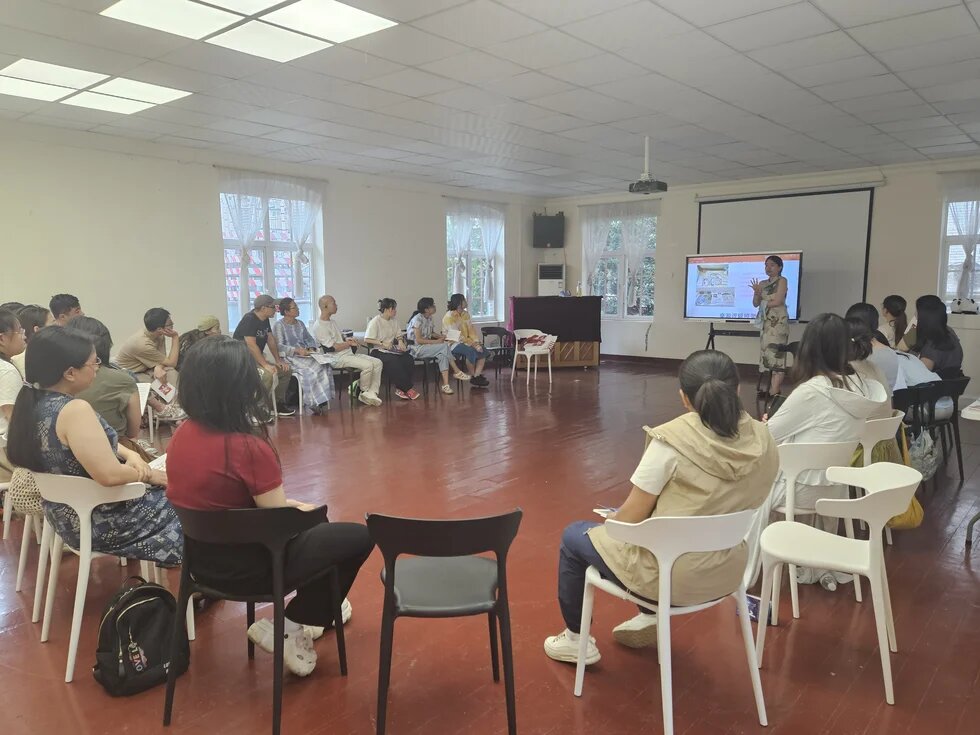
The Beijing Representative Office works hand in hand with civil society organizations across China, helping to amplify a diverse chorus of voices calling for an ecological and socially just transition.
Our partner CYCAN (China Youth Climate Action Network) brings young people from across China together and sharpens their awareness of climate change — bringing them together in formats that conventional engagement often keeps closed.
We're introducing their work and spoke with Ms. Silu Zhang, Secretary General of CYCAN.

Silu Zhang is Secretary General of CYCAN (China Youth Climate Action Network) since 2021.
Since becoming Secretary General of the CYCAN in 2021, Silu Zhang has led the organization through a strategic transformation to better respond to the needs and aspirations of young people engaging with climate issues. Under her leadership, CYCAN has refined its mission and developed innovative approaches to climate engagement, creating accessible pathways and inclusive platforms for youth from diverse backgrounds. In this interview, Silu reflects on her journey, the evolution of working approaches of CYCAN, and her vision for youth participation in climate action.
Part 1 - Personal experience and working with the Youth
Silu, what first drew you to this cause?
I studied sociology at Sun Yat-sen University, where I got interested in social development and individual growth. Before joining CYCAN, I worked at a community foundation. This position offered broad exposure across branding, fundraising, grant making, and operations. However, when it came to driving social transformation, I experienced a persistent sense of disconnect. I found myself feeling unfulfilled, as I was unable to contribute to these larger societal issues in a meaningful way.
Was there a specific moment that made it feel urgent to get involved in addressing social issues?
When we first talked about climate change, we were still asking "how to avoid disasters". A few years later, we started discussing "how to survive alongside it”. Recently, "loss and damage" has taken center stage. The shift in focus indicates that the effects of climate change are already reshaping our reality. The sense of urgency developed over time.
You’ve spoken about the urgency driven by the visible impacts of climate change. Looking at young people in China, what do you see in the way they relate to this issue today that most outsiders miss?
Recently, I attended a lecture by Xiang Biao1 at Sun Yat-sen University on the last day of the public holiday. The main classroom was fully packed with 300 people, and three additional classrooms were set up to accommodate the overflow crowd via live broadcasting. The audience was entirely young people, all eager to hear from their intellectual superstar in anthropology.
During the pandemic, Xiang Biao gained massive popularity for his insightful posts on the internet. He used anthropological theories to explain his viewpoints, arguing that "the disappearance of the nearby” causes us to focus on ourselves and distant issues, while disconnecting us from our immediate reality, and defining "involution (内卷)”2 as a form of relentless internal competition that allow no room for failure or retreat. By “using himself as a method”3, he offered a lifeline to confused young people, providing them with a framework and practical guidance for navigating modern challenges.
Addressing the crowd of young people, Xiang Biao noted that the perceived lack of youth public engagement may simply reflect a mismatch between supply and demand. The desire to participate is there, but the opportunities aren't.
His assessment is refreshing. When we truly take young people seriously, how do we properly respond to their needs? Instead of complaining that youth have lost their social drive, we need to ask: How do we create effective platforms to draw them into climate action?
What has changed these needs?
I would point to three major developments: The lingering impact of the pandemic, the economic downturn and a general shift towards a more conservative society. These factors are driving young people to become more inwardly focused, inevitably reducing their willingness to engage publicly. Unfortunately, this triggers a vicious circle: When young people hesitate to show up, the groups organizing activities lose momentum and decrease in number. As the soil for public discourse becomes less fertile, it becomes increasingly difficult to cultivate the next generation of active civic participants.

And this is why it’s relevant in China to invest in in-person offline spaces?
Online platforms are great for reach, but offline spaces are essential for depth. While social media platforms like Douyin (TikTok) are becoming a primary way Chinese youth access climate information, climate engagement requires diverse options, especially offline participation. When digital connection provides instant, viral feedback, physical human interaction unlocks something entirely different: meaningful conversations, detailed observations, and transformative, real-world experiences.
Your mission is to inspire young people to take action on climate change. Yet you describe their engagement as largely transactional. How do you navigate that tension — and how do you turn it into something deeper?
Many people claim to have basic awareness of climate change, stating that it threatens the Earth, our shared home, and that they bear a personal responsibility. Yet, this awareness rarely translates into tangible action. From our perspective, real change only occurs when young people are actively mobilized. That is why creating the appropriate spaces is so critical. They are essential hubs for youth to gather their voices, share their ideas, and cultivate meaningful actions.
Part 2 - Organizational Response & Strategy
When you realized conventional approaches weren't working, what did you do differently - and what pushed you in that direction?
Traditional approaches such as lectures given by invited experts in large venues at universities or research institutions remain appealing. However, young people have already experienced extensive didactic learning in traditional education systems. Recognizing this, we aspire to offer something different. Our greatest advantage is our agility; the low cost of trial and error allows us to conduct innovative experiments that can be easily scaled once proven effective. Over the past few years, our approaches, including board games, co-learning, or theater, have gained widespread recognition. We are now seeing our peers and other organizations adopting similar approaches. We think this is great to promote more communication and encourage ourselves to keep innovating – especially as a lean NGO with just three full time staff members we need to clearly understand our position and maximize our charitable funds. Seeing this field attract more investment and participation is exactly what fuels my passion to keep pushing boundaries. Together we join hands to build a more dynamic, inclusive, and diverse climate sector.
What do these formats enable that more conventional approaches — such as lectures or campaigns — might not?
Utilizing these interactive formats to discuss climate change substantially boosts the engagement of young people, by creating a relaxing environment for learning and dialogue, and lowering the barriers to build their autonomy on climate-related issues. Conventional education system relies on passive reading and listening, which is not easy for many. As an NGO, we are expected to differentiate our approach and make climate knowledge accessible to effectively attract young people. We are also committed to reaching groups with diverse learning needs, including those who may face cognitive or learning challenges.
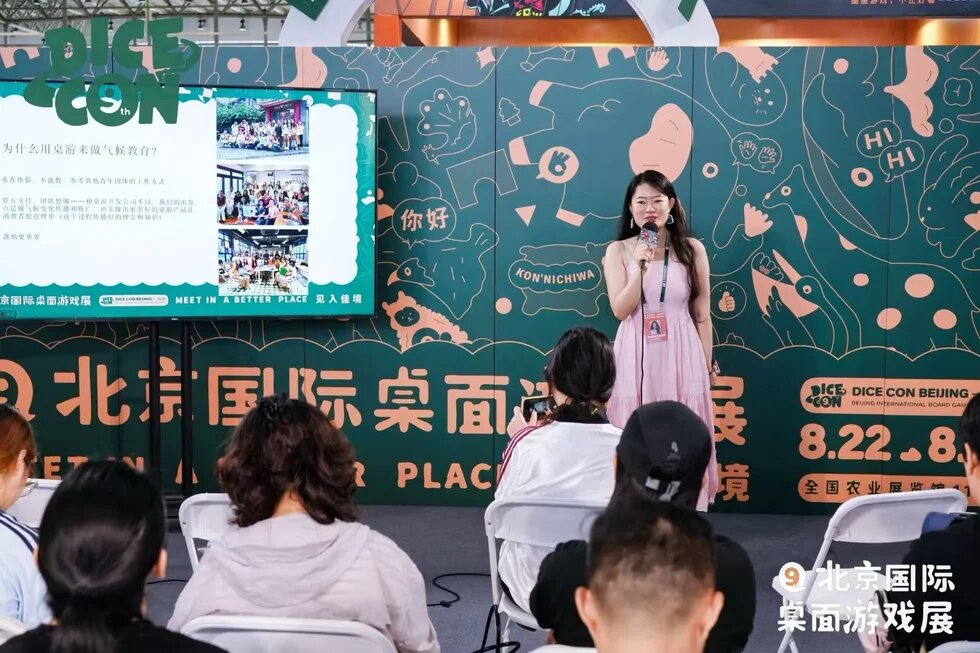
The board game format was adopted because a 2020 research report4 showed that young people prefer experiential learning — so our team simply designed around that insight. And the theatre format stems from my university exposure to Augusto Boal's People's Theatre5, which combines art with social change and draws on Paulo Freire's concept of “liberation education"6. It was the underlying philosophy, not just the medium, that really drew me in.
You've trained facilitators for these activities across different communities and regions. What have you observed about how climate conversations land differently depending on where you are?
Climate challenges vary slightly across different regions, and the personal awareness and interests of the facilitators also shape the discussions. So, session topics may naturally range from extreme weather, ESG to global geopolitics. Facilitators often adapt their approaches based on their audience. For example, they may discuss the mobility challenges of extreme hot weather with disabled communities, or focus on carbon reduction actions with parent-child families. Throughout this process, it is vital to encourage the facilitators to exercise their personal initiative.
You have reached many young people already. What comes next for them?
We aim to empower young people to explore their personal development and discover various possibilities within the climate sector. We want to help them find their own space for expression and build confidence in their ability to make a difference. To achieve this, we must create more opportunities for meaningful participation and provide more space for action, inspiring the young people to take continuous initiative and drive real change in the climate space.

Footnotes
- 1Anthropologist and Director of the Department of Anthropology of Economic Experimentation at the Max Planck Institute for Social Anthropology in Halle (Saale), Germany.
- 2Neijuan (内卷) is the Chinese calque of involution. Since 2020, the word involution (neijuan) has become an internet slang word in mainland China, and by extension refers to a culture in which people are expected to keep ahead of others.
- 3The concept of "the self as method" (ba ziji zuowei fangfa), as proposed by the Chinese anthropologist Xiang Biao, emphasizes grounding one's understanding of the world in personal, embodied experience. It is a methodological approach that insists on starting from one's own concrete and situated life experiences. It can be traced in Xiang Biao, Self as Method: Thinking Through China and the World, trans. David Ownby (Singapore: Palgrave Macmillan, 2023).
- 4Chinese Youth Climate Awareness and Behavior Survey Report was a survey carried out by the China Youth Climate Action Network, surveyed over 5,000 people between the ages of 18-24 at universities across the country in 2020.
- 5Augusto Boal's Theatre of the Oppressed (often associated with people's theater) is an interactive, community-based methodology developed in the 1960s to transform passive spectators into active "spect-actors". It empowers marginalized groups to collectively analyze and rehearse solutions to real-life social and political struggles
- 6Freire’s “liberation education” is a pedagogical theory and practice that opposes the traditional “banking model” of education—in which teachers deposit knowledge into passive students—and instead advocates for a dialogical, problem-posing approach that fosters critical consciousness. For Freire, liberation education is a means of humanization, enabling learners to recognize, analyze, and act against social, political, and economic oppression. Key to this framework is the development of critical reflection and action upon the world, so that individuals can become subjects of their own history rather than objects of others’ control.